
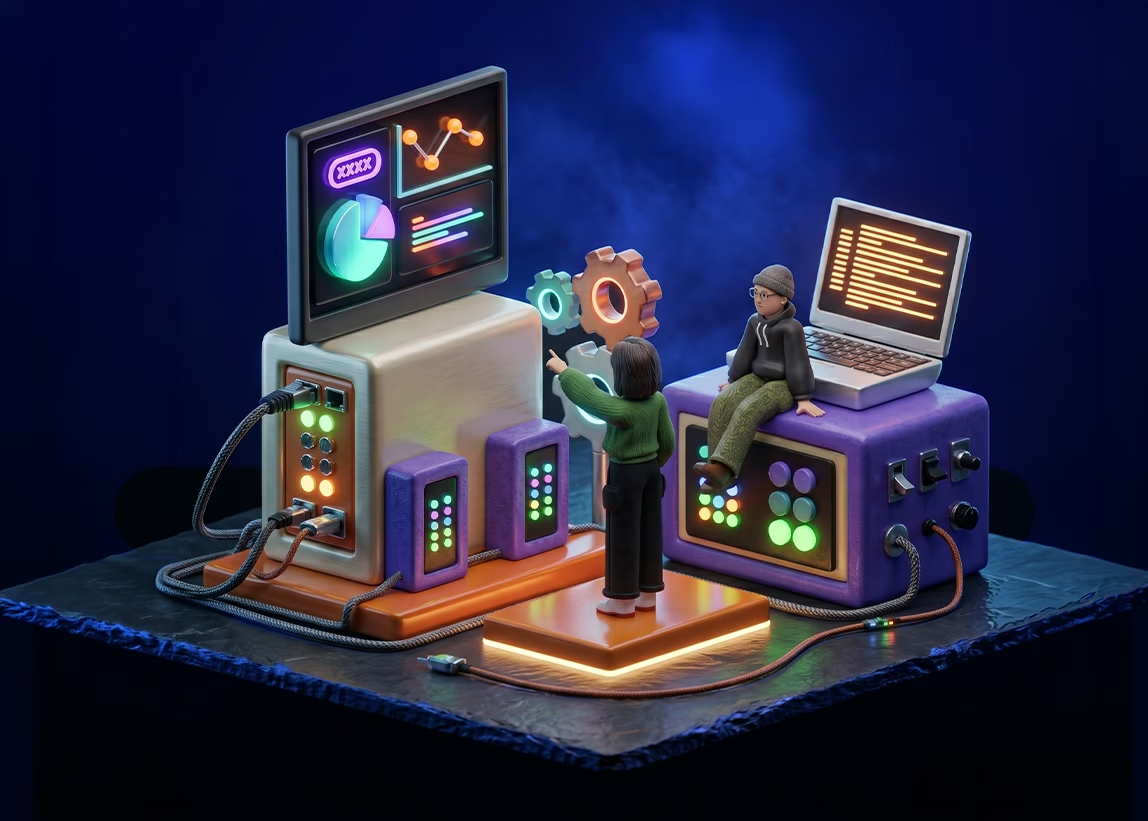
It is a normal Tuesday at a medium sized financial company. A young product manager wants to impress the boss. They need a new tool to track when customers leave the company. In the past, this meant asking the tech team for help and waiting three months. Today, the manager opens a new AI tool. They type a simple sentence: “Build a web page that connects to the main database and shows me the latest customer numbers.”
The AI works for thirty seconds. It produces a perfect, working web page. The manager is thrilled. They put the code on the company server and share the link with their team. What the manager does not know is that the AI took a massive shortcut. To make sure the page worked on the first try, the AI included the master password for the database directly in the text of the program. By Wednesday morning, outside bots find the password. The company faces a major data leak.
This is not a story about a spy breaking into a secure building. It is a story about a helpful employee who tried to work faster. This is the reality of a new trend that tech experts call “vibe coding.”
In early 2025, Andrej Karpathy, former head of AI at Tesla and a founding member of OpenAI, was the first one to describe this change. He noted that the most popular new programming language is simply English.
He described a future where people no longer write computer instructions line by line. Instead, you talk to an AI tool. You describe what you want. You let the machine handle the messy details. You focus on the big picture, or the “vibe,” and the AI does the heavy lifting.
This sounds like a dream for business. It means anyone can build software. But as this practice moves from small home projects into massive corporations, it is creating a serious new risk. Security teams call it the new insider threat. It is the danger of Accidental Risk. This is an employee who uses AI to move at lightning speed but unknowingly tears down the company’s security walls along the way.
The Death of the Careful Builder
To understand why this is so dangerous, we have to look at how software used to be made. For decades, writing code was a slow and careful craft. It was like building a brick house. You had to place every brick perfectly. You had to understand how the roof connected to the walls.
Security was a natural part of that slow process. The work was hard. If a programmer wanted to build a system to process credit cards, they had to spend days learning how to lock the digital doors and hide the private data. The extreme difficulty of the task acted as a natural safety net. You could not build something complex without learning the rules first.
Vibe coding has completely removed that safety net. With modern AI tools, a person does not need to know the rules. A marketing director can create a custom data tool over their lunch break. A human resources worker can write a program to sort through private employee files in ten minutes.
The core problem is that AI tools are built to please the user, not to protect the company. If you ask an AI to make something work, it will find the shortest possible path to a working product. Very often, that path involves taking dangerous shortcuts that a trained human expert would never consider.
The False Sense of Safety
Security teams are currently fighting a massive problem. They call it the false sense of safety. This happens when a regular employee sees AI code that looks clean, neat, and runs perfectly on the first try. The employee assumes that because the code works so well, it must be safe to use in the real world.
When security experts actually look at the code produced by vibe coding, they find the same dangerous flaws over and over again. These flaws usually fall into three main groups.
- The Wide Open Doors
When an AI writes a web application, it wants to make sure the app does not crash when the user tries to test it. To prevent errors, the AI will often suggest network settings that are completely open. It tells the app to accept a connection from anyone, anywhere. If an employee does not know how to lock those doors before the app goes live on the internet, outside attackers can walk right in and take whatever data they want.
- Outdated Advice
AI models learn by reading billions of pages of old computer code from the internet. When an employee asks the AI to protect sensitive data, the AI looks back at what it read. It often suggests security methods that were popular ten years ago but have since been broken by modern computers. To the AI, these old methods look like a common and popular solution. To an attacker, these old methods are an easy target. The AI is essentially handing out weak locks.
- Fake Building Blocks
Modern software is built using thousands of small, pre written parts called libraries. In a rush to finish a complex task, an AI might suggest using a library that does not actually exist. It simply makes up a name that sounds correct.
Hackers have realized this is happening. They look for the fake names that AI tools frequently make up. The hackers then create their own bad software and give it that exact fake name. They put this bad software on the internet. They just wait for a vibe coder to ask their AI for help, get the fake name, and accidentally download the hacker’s trap.
The Rise of the Well Meaning Danger
When companies think about an insider threat, they usually picture someone trying to do harm. They picture an angry worker stealing files or a spy selling secrets to a rival company.
The vibe coding threat is entirely different. The person causing the damage is usually trying to help the company succeed. They are trying to finish a project early. They are trying to save the company money by not hiring an outside expert.
But good intentions do not stop data leaks. By moving at a speed that the company’s safety rules cannot match, these helpful employees become more dangerous than an actual attacker. They are bypassing all the normal checks and balances because the AI makes the work feel so easy.
The Problem of the Black Box
Beyond the immediate danger of data leaks, vibe coding is creating a massive long term problem for businesses. It is causing a total loss of understanding.
When a worker uses an AI to write two thousand lines of code, they do not really know how that code functions. They know what the final product does, but they cannot explain the step by step logic hidden inside.
If that worker eventually leaves the company, they leave behind a black box. The company now relies on a piece of software that no human being truly understands.
This becomes a nightmare when a new security flaw is found in the global tech world. When a major flaw makes the news, IT teams have to check all their internal systems. In a normal company, experts can read the code to see if they are at risk.
In a company that relies heavily on vibe coding, this is impossible. Nobody knows what the code is actually doing. The AI wrote it, the human trusted it, and now the company is stuck with a system that is impossible to check, fix, or update safely. The company loses control of its own digital foundation.
Finding a Safe Path Forward
Companies cannot simply ban vibe coding. The speed it offers is too valuable. A company that bans AI will lose to a rival company that uses it to build products faster. Instead of trying to stop the trend, smart businesses are learning to put strict rules around how people use these new tools.
- The Student Rule
The most successful companies have changed how they view AI. They do not treat it as an expert. They treat it like a very fast, very smart, but very messy student. You are allowed to use the student’s work, but a human expert must review every single line. If the employee cannot explain exactly what the AI code does, the company does not allow them to use it.
- Real Time Safety Tools
Since employees use AI to move incredibly fast, the security checks must move fast as well. Companies are now buying new safety tools that watch the code as the AI writes it. These tools act like an automatic spell checker, but for security. They flag risks like secret passwords or weak locks before the worker even has a chance to save the file.
- The Two Sentence Test
Many tech teams are using a very simple rule to prevent the black box problem. It is called the two sentence test. If an employee uses AI to build a new tool, they must be able to explain how the core logic works in two simple sentences. If they cannot do that, the tool is not ready for the real world.
- AI Governance Platforms To manage this massive shift, businesses are turning to AI governance platforms. These systems act like a central control tower for the entire company. They track exactly who is using AI, what kind of code they are generating, and where that code is being saved. Instead of just hoping employees follow the rules, these platforms give security teams a clear view of all AI activity, making sure no one is quietly building a dangerous system in the background.
The Bill Always Comes Due
Let us return to that young product manager at the financial company. They got their project done fast. They impressed the boss for exactly one day. Then the data leak happened. The company saved three months of developer time, but they will spend the next three years paying for the damage.
This is the final lesson of the new tech era. Giving an AI tool to an untrained worker is like handing a race car to someone who has never driven before. They will move incredibly fast right up until the moment they crash.
The new threat hiding inside modern businesses is not a villain. It is a very eager, very helpful person who thinks speed is more important than safety. Vibe coding makes it dangerously easy to stop thinking. But in the real world of professional security, feeling good about your code will never stop a cyber attack. To survive the future, businesses must enjoy the speed of the machine while keeping both hands firmly on the steering wheel.