“AI SOC” has become one of the most common terms in enterprise security, and it now covers a wide range of very different products. For some vendors it means a chatbot connected to a SIEM. For others it is the automation the industry has used for years, described in newer language. For a few it means software that genuinely investigates threats on its own. The same two words apply to all of them.
That makes the term hard to buy against, so it is worth understanding what sits underneath it: what the AI actually does, what it does that a human cannot, and where it still falls short. The short answer on whether you need one is yes, though usually not in the form it is most often sold.
Start with what a SOC is
A Security Operations Centre watches your systems for attacks and deals with them before they become a breach. The old way of running one is people. Junior analysts sit in front of an alert queue all day and sort the real signals from the noise. More senior people pick up what the juniors escalate. The most experienced handle the genuine incidents and go hunting for the things no alert caught.
The problem with that model is not the people. It is the volume. A mid-sized company’s security tools now throw off thousands of alerts a day, and by late 2025 the average mid-market team was looking at more than four thousand. Nobody works through four thousand alerts properly. What happens instead is that analysts learn to ignore whole categories of “noisy” alerts just to keep the queue moving, and attackers know it.
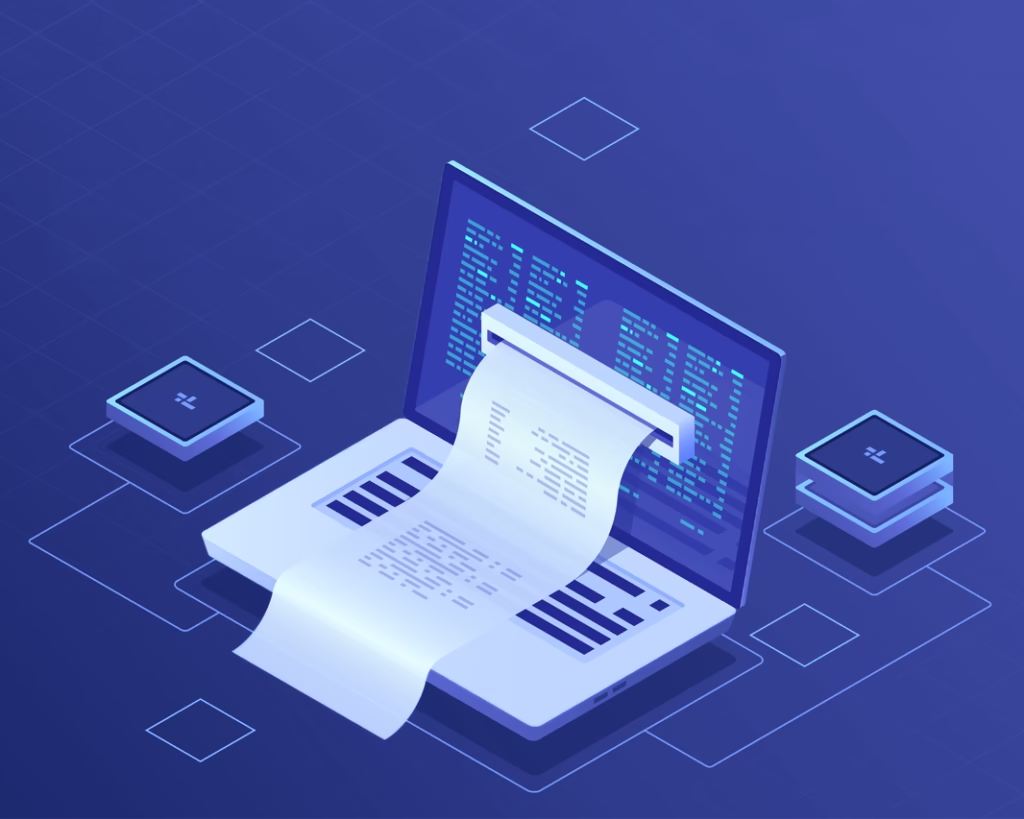
An AI SOC takes that grinding, high-volume first layer and gives it to software. The AI reads the alerts, adds context, joins up signals that came from different tools, and decides what is worth a human’s attention. Your analysts stop drowning in triage and go back to doing the part of the job that needs a brain.
What that looks like with a real alert
Here is the difference in practice. An account triggers a sign-in alert at two in the morning.
In a normal SOC, the alert waits in the queue. Eventually an analyst opens it, checks the source IP against a threat feed in one tab, looks the user up in the directory in another, works out whether the device is company-managed, scrolls back through the account’s recent activity, and makes a call. If they are quick and the alert happens to be near the top of the pile, that is twenty minutes. It is usually not near the top of the pile.
An AI SOC does the same checks the instant the alert fires. It sees the login came from an unmanaged device in a country the user has never used, works out that the person would have had to fly there faster than physics allows since their last login in Dubai, and then looks sideways at what else the account has been up to. It finds a mailbox rule created four minutes earlier that quietly forwards anything mentioning invoices to a Gmail address. It tags the whole sequence against the MITRE ATT&CK framework, calls it a probable account takeover in progress, writes up the evidence, and hands a human a finished case with a recommendation: kill the session and reset the password now.
The analyst reads an investigation instead of starting one. Two minutes, not forty, and it happened whether or not anyone was awake.
This is also why AI matters against attacks that target people rather than machines. There was a case where criminals used AI-generated video and audio to pose as a company’s CFO on a live call and talked a member of staff into wiring twenty-five million dollars. The employee trusted their own eyes. A human checking the request had no way to catch it. A system watching the telemetry would never have looked at the video at all. It would have seen the CFO logging in from a device nobody recognised, from the wrong place, at impossible speed, and stopped the payment.
The three things “AI SOC” usually means
When a salesperson says “AI-powered,” push on what they mean, because it is one of three very different things.
Often it is a chatbot with a security badge. A language model wired into your SIEM so you can ask questions about your alerts in plain English. Handy. It saves time. But it does not do anything on its own and it does not learn your environment. It answers when spoken to. That is a copilot, and a copilot is only ever as fast as the person typing at it.
Sometimes it is the automation everyone already had, wearing a new label. If this alert fires, run these steps. Useful for years, genuinely. But the logic is fixed rules, and rules cannot handle the attack nobody wrote a rule for.
The third kind is the one that earns the name. Software agents that actually run an investigation: pull the evidence, check it, follow where it leads, reach a verdict, all inside limits a human set. This is where the industry is going. It is also where almost nobody is yet, despite what the demos imply. The technology is real and the direction is right. The distance between a polished demo and something you would trust on a Tuesday night is still large.
Why most companies are not ready for the clever version
There is a sensible order to putting AI into a SOC, and the order is where people waste their money.
First your logs have to live in one place and speak the same language. Microsoft 365, Entra ID, the firewalls, the endpoints, the cloud accounts. If they are scattered across separate consoles, any AI sitting on top is reasoning from half the picture and will hand you confident answers built on gaps.
Then the detections have to be written and tuned so the system links related events and stops shouting about nothing. This is dull work. It is also the work that actually cuts your alert noise, and there is no clever model that lets you skip it.
Only after that does AI-assisted triage start to pay off, and only after a long stretch of that does it earn any right to act on its own, on the narrow cases where it has proved it can be trusted.
The catch is that vendors sell the last step and most companies have not finished the first. Put an AI layer on messy, half-connected logging and you have bought a faster way to miss things. Get the boring parts right and everything above them starts to work. That is the whole game, and it is not glamorous.
The humans are not optional
The fully autonomous SOC that runs itself is being sold harder than it can be trusted. Agents still get things wrong, invent things that are not there, and get stuck going in circles on anything complicated. A good chunk of these projects never make it out of pilot. None of that makes the technology fake. It means you let the software earn autonomy slowly, one narrow task at a time, with someone able to pull the plug.
And some decisions stay with a person no matter how good the model gets. Pulling a finance director’s laptop off the network in the middle of the working day. Telling a client their data is gone. Picking up the phone to a regulator inside the window NESA or SAMA gives you. A wrong automated containment at the wrong moment can take down a live system and cost you more than the attack would have. So the sensible setup keeps a named human responsible for the actions that hurt if you get them wrong, with the AI doing the heavy lifting underneath and a hard ceiling on what it can do unsupervised.
If a vendor tells you their SOC needs no humans, what they are selling you is the liability.
What it costs, and why most UAE firms should rent not build
Running this yourself is not a project with an end date. A round-the-clock SOC needs enough analysts to cover three shifts plus the holidays and the sick days, which in reality is six to eight skilled people before anyone has looked at a single alert. On top of that sit the platform licences, the threat feeds, the AI tooling, and the engineer who keeps the detections tuned so the whole thing does not rot. For most organisations in the UAE that figure does not stack up against the risk they are actually carrying.
Renting it from a managed provider changes the maths. The analysts and the platform are shared across a client base, so you are not paying a night shift to sit idle waiting for your alert. A two-hundred-person firm in Dubai gets the same machine-speed detection as a bank, governed by people who do this every day, without hiring any of them. The unglamorous groundwork, the log unification and the tuning, is handled by a team that has done it fifty times rather than learned it the hard way on your network.
Questions worth asking before you sign
The marketing will not tell you which of the three kinds you are looking at. These will.
Does it actually do anything, or only answer questions? A tool that explains your alerts beautifully but takes no action is not cutting your response time on its own.
What happens when something turns up that nobody wrote a playbook for? If the real answer is “nothing,” you are buying rules with an AI sticker on them.
Show me, in numbers, how this brings down our time to detect and respond. Not the demo. The metric, and how it is measured.
What can the system do without a human, and where exactly does the human come back in? You want a clear line, not a reassuring wave of the hand.
Who does the log unification and the detection tuning, and is it in the price? That is the work everything else depends on, and it is where the cost usually hides.
And how does any of this fit our reporting duties under NESA, the NCA ECC, SAMA, or PCI-DSS? A SOC that ignores the rules you answer to has solved one problem and handed you another.
Where iConnect fits
We run a managed SOC out of Dubai, with our own analysts watching client environments at all hours. We use AI where it earns its keep: joining up signals across cloud and on-premises, stripping out the alert noise that hides the real thing, and putting the cases that matter in front of an analyst fast. We do the log unification and the tuning first, because nothing above that works without it. And the decisions that carry weight stay with a person who investigates, confirms, and owns the call, with your NESA, NCA ECC, SAMA, and PCI-DSS obligations kept in view the whole way.
If you want to know how fast your current setup would actually catch someone, book a thirty-minute review with our team. We will look at how your logs are wired and where the gaps are, work out which step of all this you are really standing on, and tell you plainly whether an AI-assisted SOC would help you yet or whether you have groundwork to do first.