
The State of Managed Security in 2026
The era of “set it and forget it” cybersecurity is effectively dead. In 2026, the digital perimeter has evaporated, replaced by a complex ecosystem of cloud infrastructure, remote endpoints, and AI-driven threat vectors. For organizations attempting to navigate this volatile landscape alone, the odds are increasingly stacked against them.
This creates the critical context for Managed Security Services (MSS).
What is MSS? A Modern Definition
At its core, the MSS definition refers to the practice of outsourcing the monitoring and management of security devices and systems to a specialized third-party provider. However, the scope of these services has expanded drastically over the last decade.
What is MSS in 2026? It is no longer just about configuring firewalls or updating antivirus software. It is a transition from passive alert monitoring to holistic cyber defense. Modern MSS providers (MSSPs) now function as strategic partners, integrating:
- Continuous Threat Exposure Management (CTEM)
- AI-driven behavioral analysis
- Proactive threat hunting
- Automated incident response
The Economic and Operational Imperative
The shift toward outsourced security is not merely a technical decision; it is a financial necessity driven by two escalating factors: the cost of failure and the scarcity of talent.
1. The Asymmetric Cost of Breaches
The financial impact of a security incident has reached unsustainable levels. With data privacy regulations becoming more aggressive globally, the cost of a single breach involves not just immediate remediation, but massive regulatory fines, legal fees, and long-term reputational damage.
- Reality Check: In 2026, the global average cost of a data breach continues to climb, pushing mid-sized enterprises toward insolvency if they lack robust defense mechanisms.
2. The Widening Cybersecurity Skills Gap
Perhaps the biggest driver for MSS adoption is the cybersecurity skills gap. The demand for Tier-2 and Tier-3 security analysts far outstrips the available supply.
Building an internal Security Operations Center (SOC) that operates 24/7 requires a minimum of 8 to 12 dedicated experts. For most organizations, recruiting, training, and retaining this talent is cost-prohibitive. MSSPs bridge this gap by providing economies of scale, granting access to top-tier talent and cutting-edge technology stacks for a fraction of the cost of an in-house build.
As we move through this guide, we will dismantle the complexities of Managed Security Services, ensuring you have the knowledge to select the right partner for your defense architecture.
Core Components: What Do MSSPs Actually Do?
If the introduction established the why, the hostile landscape and the evaporation of the perimeter, this section defines the what.
Many organizations mistakenly view Managed Security Service Providers (MSSPs) as a monolith, a single “security box” you plug into your network. In reality, a modern MSSP functions more like a sophisticated menu of operational capabilities. You do not simply “buy MSS”; you subscribe to specific layers of protection tailored to your risk profile and infrastructure.
Below is a detailed breakdown of the functional pillars that constitute a comprehensive managed security portfolio.
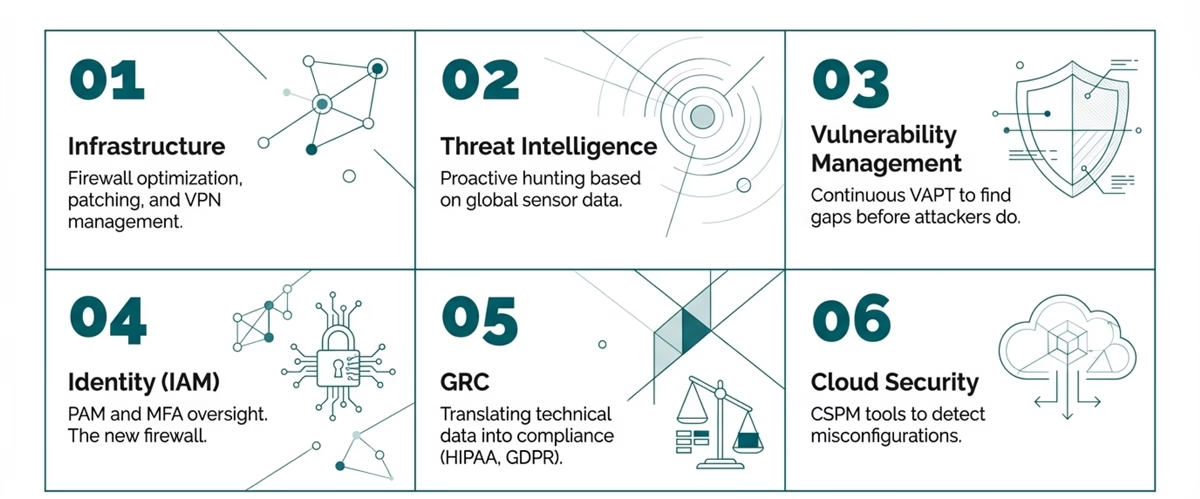
1. Infrastructure and Device Management
At the foundational level, MSSPs take over the burden of maintaining your security hardware and software. This is often the entry point for many enterprises, shifting the tedious maintenance of “keeping the lights on” to external experts.
- Managed Firewall Management: This goes beyond initial setup. MSSPs handle rule-set optimization, patching, and configuration changes. They actively prevent “rule decay” where conflicting or obsolete rules leave gaps open and ensure the firewall adapts to new traffic patterns.
- Intrusion Detection Systems (IDS) & IPS: While firewalls control access, Intrusion Detection Systems (IDS) and Prevention Systems act as the internal surveillance grid. MSSPs tune these systems to distinguish between legitimate high-volume traffic and actual malicious anomalies, reducing the noise of false positives that often overwhelm internal teams.
- VPN Management: With the hybrid workforce now the standard, secure remote access is non-negotiable. MSSPs manage the encryption protocols, user authentication, and tunneling configurations required to keep remote connections secure without sacrificing speed.
2. Proactive Threat Intelligence and Analysis
Reactive security is insufficient in 2026. Top-tier MSSPs do not wait for an alert to trigger; they actively hunt for emerging dangers.
- Threat Intelligence: This is the brain of the operation. MSSPs aggregate data from thousands of clients, global sensor networks, and dark web forums. By analyzing this vast dataset, they provide Threat Intelligence that predicts attacks before they happen. If a specific ransomware strain hits a retailer in Asia, your MSSP updates your defenses in North America immediately.
- Threat Hunting: Human analysts use AI-driven tools to comb through your network logs, looking for “low and slow” indicators of compromise that automated tools might miss.
3. Vulnerability Management and VAPT
Knowing your weaknesses before an attacker finds them is critical. MSSPs provide a continuous loop of assessment and remediation.
- Vulnerability Scanning: Automated, scheduled scans that crawl your network, endpoints, and applications to identify known security gaps, such as unpatched software or misconfigurations.
- Vulnerability Assessment & Penetration Testing (VAPT): While vulnerability scanning is automated, penetration testing is manual and adversarial. Ethical hackers employed by the MSSP attempt to breach your defenses using the same tactics as cybercriminals. The result is a prioritized roadmap of what needs fixing, ranked by actual exploitability rather than just theoretical risk.
4. Identity and Access Management (IAM)
As the traditional perimeter vanishes, identity has become the new firewall. MSSPs manage the lifecycle of user identities to ensure Zero Trust principles are enforced.
- Privileged Access Management (PAM): Monitoring and controlling super-user accounts that have the power to alter core systems.
- Multi-Factor Authentication (MFA) Oversight: Managing the deployment and maintenance of MFA protocols across complex, multi-cloud environments to prevent credential stuffing attacks.
5. Compliance, Governance, and Risk (GRC)
For many organizations, regulatory adherence is just as frightening as a cyberattack. MSSPs translate technical security data into business-centric compliance reports.
Whether it is HIPAA, GDPR, PCI-DSS, or SOC2, MSSPs automate the collection of evidence. They ensure that log retention policies meet legal standards and provide real-time dashboards showing compliance posture, saving internal teams hundreds of hours during audit season.
6. Cloud Security Posture Management (CSPM)
With infrastructure moving to AWS, Azure, and Google Cloud, the risk of misconfiguration is high. MSSPs utilize CSPM tools to continuously monitor cloud environments. They detect unsecured S3 buckets, permissive IAM roles, and lack of encryption, automatically remediating these issues to prevent cloud-native breaches.
The “Menu” Approach
Ultimately, the value of an MSSP lies in scalability. A small business may only require firewall management and basic antivirus monitoring. A multinational enterprise, however, will likely engage the full spectrum, from VAPT to deep-dive Threat Intelligence.
Understanding these components allows IT leaders to stop asking “Do we need an MSSP?” and start asking “Which functions should we offload to maximize our security posture?”
Defining the Ecosystem: MSSP vs. MSP vs. MDR vs. SIEM
Understanding the capabilities of a security partner is useless if you cannot distinguish their service model from the adjacent market. The cybersecurity industry is plagued by an “alphabet soup” of acronyms that often overlap, confusing decision-makers and obscuring value.
To select the right partner, you must distinguish between general IT maintenance, reactive security monitoring, and proactive threat hunting. Here is how the ecosystem breaks down.
MSSP vs. MSP: Administration vs. Protection
The most fundamental confusion lies in the battle of MSSP vs MSP. While both provide third-party management, their objectives are diametrically opposed.
- Managed Service Providers (MSP): Focus on IT availability and usability. They ensure your email works, your servers are patched, and your helpdesk tickets are resolved. Their primary metric is uptime.
- Managed Security Service Providers (MSSP): Focus on risk reduction and defense. They monitor firewalls, analyze logs for anomalies, and manage compliance. Their primary metric is security posture.
The Verdict: An MSP might resell antivirus software, but they rarely have the 24/7 specialized expertise to analyze a complex intrusion. You hire an MSP to build and maintain the house; you hire an MSSP to guard it.
MSSP vs. MDR: Reactive Alerting vs. Proactive Hunting
As cyber threats evolved from simple malware to human-operated ransomware, the traditional MSSP model revealed a weakness. It was too reactive. This gap gave rise to Managed Detection and Response (MDR).
- Traditional MSSP: Typically relies on a “monitor and notify” model. They manage security devices and send you an alert when a rule is triggered. The remediation is often left to your internal IT team.
- MDR: Focuses on “detect and destroy.” MDR providers do not just wait for alarms; they actively hunt for threats that bypass standard controls. Crucially, they possess the authority to take action, isolating infected endpoints or killing malicious processes remotely.
The Verdict: If you only need to tick a compliance box for log monitoring, an MSSP is sufficient. If you need a partner to actively fight an attacker inside your network at 3:00 AM, you need MDR.
SIEM vs. SOC: The Tool vs. The Team
Finally, we must clarify the relationship of SIEM vs SOC. These are not competing service models; they are the engine and the driver.
- SIEM (Security Information and Event Management): This is the software. It aggregates log data from across your infrastructure, correlates events, and highlights anomalies. However, a SIEM is useless without interpretation.
- SOC (Security Operations Center): This is the human element. The SOC is the team of analysts, engineers, and researchers who operate the SIEM, interpret the data, and execute the response.
The Verdict: You cannot buy a “SIEM” to solve your security problem any more than you can buy a stethoscope to perform heart surgery. An MSSP or MDR provider supplies the SOC that makes the SIEM effective.
Which Model Fits Your Maturity Level?
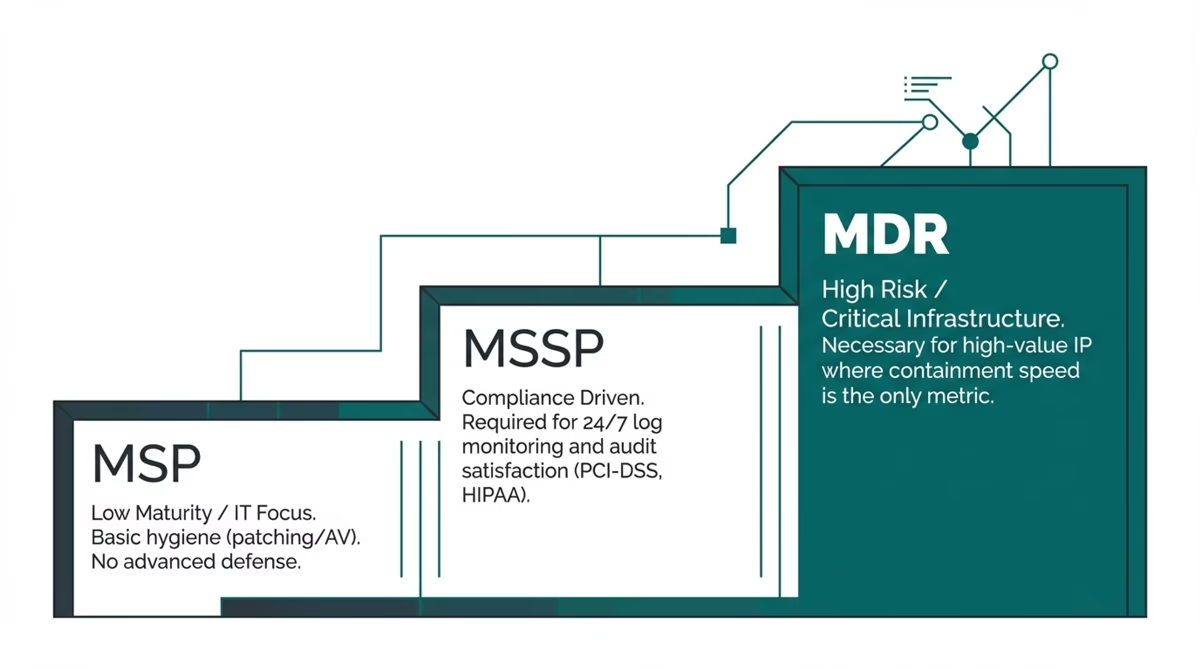
To summarize, align your choice with your organizational maturity and risk appetite:
- Low Maturity / IT Focus: Stick with an MSP for basic hygiene (patching/AV), but understand you have no advanced defense.
- Compliance Driven: Engage an MSSP. Perfect for organizations that need 24/7 log monitoring and device management to satisfy auditors (e.g., PCI-DSS, HIPAA).
- High Risk / Security Driven: Invest in MDR. Necessary for organizations protecting high-value IP or operating in critical infrastructure where containment speed is the only metric that matters.
The Business Case: Benefits and ROI of Outsourcing
Once you navigate the acronyms and understand the technical capabilities, the decision inevitably shifts to the balance sheet. For most organizations, the choice between building an internal Security Operations Center (SOC) and partnering with an MSSP is not decided by technology, but by economics.
The Cybersecurity ROI of outsourcing stems from converting a massive, unpredictable capital expenditure (CapEx) into a predictable, scalable operating expenditure (OpEx).
The “Build vs. Buy” Calculus
The most common misconception in cybersecurity is underestimating the true cost of an in-house SOC. Many executives believe that hiring two security engineers covers their needs. In reality, effective security requires continuous eyes on glass.
To achieve genuine 24/7 monitoring benefits internally, the math is unforgiving:
- Human Capital: There are 168 hours in a week. A standard employee works 40. To cover shifts, weekends, holidays, and PTO without burnout, you need a minimum headcount of 5 to 6 full-time analysts. With average salaries for experienced analysts often exceeding six figures, the payroll alone can surpass $600k to $800k annually.
- The Technology Stack: Personnel costs do not include the infrastructure. You must purchase, configure, and maintain a SIEM, threat intelligence feeds, ticketing systems, and SOAR (Security Orchestration, Automation, and Response) platforms.
- Turnover and Training: The cybersecurity skills shortage leads to high staff turnover. When a senior analyst leaves an in-house team, they take institutional knowledge with them, creating a security gap and incurring recruitment costs.
In contrast, the subscription model of MSS amortizes these costs across a broad client base. You gain access to a fully mature technology stack and a deep bench of experts for a fraction of the cost of building it yourself.
Operational Agility and Focus
Beyond direct financial savings, outsourcing offers critical operational advantages.
- Scalability on Demand: If your organization acquires a new company or opens a new branch, an in-house SOC requires time to hire staff and deploy hardware. An MSSP can simply ingest the new log sources, scaling protection instantly.
- Focus on Core Competencies: When internal IT teams attempt to manage security, they often suffer from “alert fatigue,” spending hours sifting through false positives rather than driving business innovation. Outsourcing the noise allows your internal team to focus on revenue-generating initiatives.
Risk Management and Compliance
The intangible benefits of an MSSP often weigh heavier than the cost savings.
- Compliance Management: Regulatory frameworks like GDPR, HIPAA, and PCI-DSS require rigorous log retention and incident reporting. MSSPs provide the necessary reporting structures and audit trails automatically, reducing the legal liability of non-compliance.
- Liability and Peace of Mind: While you cannot outsource total accountability, you can outsource the heavy lifting of detection. Knowing that a dedicated team is hunting threats at 3:00 AM on a Sunday provides a level of assurance that a small internal team simply cannot match.
Ultimately, the business case is clear. Unless you are a massive enterprise with an unlimited budget, building a fortress in-house is rarely the most strategic use of capital.
The Rise of Co-Managed Security Services
While the ROI of full outsourcing is compelling, many IT leaders hesitate to hand over the “keys to the kingdom.” The fear of losing institutional knowledge or visibility into the network creates a valid resistance to traditional outsourcing.
The industry has responded by moving away from binary choices, all internal vs. all external, toward Co-managed security services. This engagement model is rapidly becoming the standard for mid-sized enterprises that want the muscle of a large provider without sacrificing control over their own environment.
Solving the Control vs. Convenience Dilemma
Historically, Managed Security Services were delivered as a “black box.” You sent logs to the provider, and they sent back alerts. You had no visibility into how decisions were made, and the provider lacked the business context to distinguish between a legitimate admin activity and a breach.
The co-managed approach creates a Hybrid SOC model. Instead of replacing your internal team, the MSSP integrates with them. Both parties work from the same SIEM platform, share ticket queues, and maintain transparent communication channels. This solves the dilemma by offering:
- Convenience: The MSSP handles the repetitive, high-volume “grunt work” (log collection, parsing, and 24/7 monitoring).
- Control: Your internal team retains administrative access, policy governance, and the ability to investigate specific incidents with deep institutional context.
The Shared Responsibility Model
To make this partnership work, clear delineation of duties is required. A successful co-managed engagement relies on a Shared responsibility model that typically looks like this:
- The MSSP Responsibilities:
- Providing and maintaining the security stack (SIEM, SOAR, EDR).
- 24/7/365 Tier 1 monitoring and triage to filter out false positives.
- Global threat intelligence ingestion and rule tuning.
- The Client Responsibilities:
- Contextualizing alerts that require business logic.
- Physical on-site remediation (e.g., re-imaging infected machines).
- User identity management and internal policy enforcement.
Empowering Augmented IT Staff
For mid-market organizations, the greatest advantage of co-management is the prevention of burnout. Most internal IT teams are generalists; asking them to be specialized threat hunters while also managing helpdesk tickets and server maintenance is a recipe for failure.
By utilizing augmented IT staff, you liberate your internal employees from the noise of thousands of daily logs. The MSSP acts as a filter, escalating only the high-fidelity threats that require immediate attention. This allows your internal team to pivot from reactive firefighting to proactive security architecture and strategic risk management.
How to Choose the Right MSSP: A Buyer’s Checklist
Deciding to pursue a co-managed or fully outsourced model is only the first step. The more difficult challenge lies in MSSP selection criteria. The market is oversaturated with providers ranging from world-class cyber defense firms to basic IT shops that simply rebranded their helpdesk as a “SOC.”
Selecting the wrong partner creates a dangerous paradox. You feel secure because you are paying for protection, but your risk exposure remains unchanged. To cut through the marketing noise, you must treat this not as a technology purchase, but as a critical component of vendor risk management.
The Vetting Process: Questions That Matter
Don’t waste time asking if they have a firewall or use antivirus; those are table stakes. You need to interrogate their operational maturity and human capital.
Ask these specific questions during the discovery phase:
- “What is your analyst-to-client ratio?” If one analyst is watching screens for 50 clients simultaneously, you are paying for alert fatigue, not security.
- “Do you own your technology stack, or are you reselling someone else’s?” Providers who build their own platforms often have better integration, but providers who use “best-of-breed” commercial tools (like Splunk or CrowdStrike) ensure you aren’t locked into proprietary, untransferable data formats.
- “How do you handle staff turnover?” SOC analyst burnout is real. A partner with high turnover will constantly have junior staff learning on your dime.
- “Can we see a sanitized incident report?” Demand to see what a final deliverable looks like. Is it a generic PDF, or a granular breakdown of the attack vector and remediation steps?
Decoding the Service Level Agreement (SLA)
The sales pitch is poetry. The contract is reality. The most critical area of any MSSP contract is the SLA.
Many providers offer impressive numbers that mean very little in practice. You must understand the difference between automated notification and human investigation.
Security SLA examples you should scrutinize include:
- Time-to-Acknowledge (TTA): The timer starts when an alert hits the dashboard. An automated email sent within 5 minutes counts as “acknowledgment” but adds zero value.
- Time-to-Triage: The time it takes a human analyst to look at the alert and decide if it is a false positive.
- Time-to-Notify (TTN): How fast they call you after verifying a critical threat.
- Time-to-Remediate: Warning: Most MSSPs do not offer this. They promise to tell you the building is on fire, not to put it out. If you require active containment, ensure your contract specifies “Response and Remediation,” not just “Monitoring.”
Data Sovereignty and Compliance
In a globalized economy, you must know exactly where your data lives and who is looking at it. Low-cost MSSPs often achieve their margins by offshoring their Level 1 SOC to regions with lower labor costs.
This introduces significant Data sovereignty concerns:
- Where are the logs stored? If you are subject to GDPR, CCPA, or CMMC, shipping log data across international borders may violate compliance mandates.
- Who has eyes on the glass? Even if the servers are in your country, remote analysts in another jurisdiction accessing that data can trigger legal complications regarding privacy and intellectual property.
Contract Red Flags
Before signing, have legal counsel review the exit strategy. The following are immediate red flags:
- Data Hostage Clauses: If you leave the provider, do you keep your historical log data? If the contract is vague, assume the answer is no.
- Proprietary Hardware Lock-in: Avoid “black box” appliances that become paperweights if you cancel the service.
- Vague “Best Effort” Language: In cybersecurity, “best effort” is a liability shield for the vendor. Ensure penalties for missed SLAs are financial (service credits), not just apologetic.
Choosing an MSSP is a marriage, not a transaction. The right partner becomes an extension of your team; the wrong one becomes a liability that you pay a monthly fee to maintain.
Understanding MSS Pricing Models
Once you have identified a provider that meets your technical criteria, the conversation inevitably turns to cost. Unfortunately, comparing quotes is rarely an apples-to-apples exercise. MSSP pricing models are notoriously complex, reflecting the industry’s shift from simple device management to comprehensive detection and response.
To avoid budget shock, you must understand the underlying structure of the contract.
Common Billing Structures
Most providers structure their base fees using one of three primary models:
- Per-Device: The traditional model where you pay a fee for every firewall, server, or switch monitored. This is transparent but can become prohibitively expensive for complex, infrastructure-heavy environments.
- Per-User: As organizations shift to the cloud, protecting the identity has become as critical as protecting the endpoint. This model charges based on the number of employees, regardless of how many devices they use. It offers the most predictability for growing companies.
- Tiered (Flat Fee): Providers offer “Gold/Silver/Bronze” packages with fixed scopes. While budget-friendly, these often lack flexibility when your specific needs fall outside the pre-defined tier.
What Drives Security Monitoring Costs Up?
The base fee is often just the entry point. Security monitoring costs escalate based on data volume and the depth of analysis required.
- Log Ingestion Pricing: Many MSSPs charge based on Events Per Second (EPS) or Gigabytes (GB) of data ingested. If your network generates more noise than expected, “variable” pricing can lead to monthly overage charges that double your bill.
- Data Retention: Compliance mandates (such as HIPAA or PCI-DSS) often require storing logs for 12 months or longer. Cold storage is cheap; hot storage (searchable data) is expensive.
- Active Threat Hunting: Basic monitoring relies on automated alerts. Proactive human threat hunting, where analysts actively search for undetected threats, is a premium service that significantly increases the contract value.
Hidden Fees and Budget Realities
Be wary of hidden fees buried in the fine print. Common unexpected costs include onboarding fees (setup and tuning), after-hours support surcharges, and Incident Response (IR) retainers.
The Bottom Line: If a quote seems too good to be true, it likely relies entirely on automation with zero human eyes on glass. A realistic budget for a mid-sized enterprise typically ranges from $3,000 to $10,000 per month for genuine 24/7 SOC coverage, heavily dependent on the user count and log volume.
Future Trends: AI, Automation, and Zero Trust
The ink on an MSSP contract may be static, but the threat landscape it covers is volatile. As pricing models stabilize, the actual mechanisms of defense are undergoing a radical transformation. The next generation of security services will not be defined by how many log lines an analyst can read, but by how effectively they leverage algorithmic intelligence and architectural rigor.
To stay resilient, organizations must look for providers aligned with the Future of MSSP evolution, specifically in three critical areas.
1. From Human-Speed to Machine-Speed Defense
The traditional MSSP model relied heavily on human analysts sifting through alerts. This is no longer sustainable. With ransomware encryption speeds now measured in milliseconds, human reaction time is a liability.
AI in cybersecurity is shifting from a buzzword to an operational necessity. We are seeing a transition from simple anomaly detection to predictive behavioral modeling. Modern MSSPs are integrating generative AI and machine learning to:
- Slash False Positives: AI filters out the noise of benign network traffic, ensuring analysts only see genuine threats.
- Predictive Analytics: Moving from reactive defense to proactively identifying vulnerabilities before they are exploited.
Crucially, this enables Automated incident response. Instead of waiting for a human to approve a firewall block, SOAR (Security Orchestration, Automation, and Response) platforms can instantly isolate an infected endpoint or revoke a compromised user token the moment a high-fidelity threat is detected.
2. Zero Trust Managed Services
The era of “perimeter security,” defending the castle walls, is over. With remote work and cloud infrastructure, identity has become the new perimeter. However, implementing a “Never Trust, Always Verify” architecture is notoriously complex and resource-intensive.
This has given rise to Zero Trust Managed Services. MSSPs are moving beyond managing firewalls to managing trust policies. This involves:
- Continuous Identity Verification: Ensuring that user behavior remains consistent after the initial login.
- Micro-segmentation: Limiting lateral movement by restricting access to only the specific data a user needs.
- Device Health Checks: Automatically blocking access from devices that are unpatched or lack endpoint protection.
3. Consolidation and Unified Platforms
The average enterprise security stack suffers from “tool sprawl,” often running 50+ disconnected security tools. This complexity creates blind spots.
The future lies in consolidation. Leading MSSPs are abandoning the “best-of-breed” patchwork approach in favor of unified XDR (Extended Detection and Response) platforms. By correlating data across endpoints, cloud workloads, and networks into a single dashboard, providers can visualize complex attack chains that isolated tools would miss.
The Bottom Line: When selecting a partner, do not just evaluate their current capabilities. Ask about their roadmap. If they aren’t heavily investing in automation and Zero Trust principles, they are preparing you for yesterday’s war.
Building a Resilient Security Partnership
Cybersecurity in 2026 is no longer about firewalls and antivirus alone. Organizations face a landscape of dispersed endpoints, cloud workloads, and human-driven threats. The real question is not whether to use Managed Security Services, but how to leverage them to strengthen your defenses and focus internal resources on business priorities.
MSSPs, MDR providers, and co-managed models offer different approaches depending on risk appetite, compliance needs, and operational maturity. Understanding their capabilities, SLAs, and pricing structures ensures your investment delivers measurable protection, not just reports.
The next frontier is automation, AI, and Zero Trust. Providers that integrate predictive analytics, machine-speed response, and unified platforms are positioning their clients to detect and contain threats faster, while reducing noise for internal teams.
For IT leaders, the decision is strategic. The right partner becomes an extension of your team, providing visibility, expertise, and agility. The wrong one adds complexity and risk. Selecting carefully today defines how resilient your organization will be tomorrow.